
Major Projects: The Future is Quebec
How Montreal's REM shows the way to build big

On Monday, Montreal inaugurated the final line of the Réseau Express Métropolitain (REM). There remains a final spur to connect to the Pierre Elliott Trudeau airport, but the projects main sponsor, la la Caisse de Dépôt Infrastructure (CDPQ Infra), has completed its construction.
Wait — what’s a pension fund doing building infrastructure?
This, in the age of Building Canada, is the key question. What does the public gain from having a pension fund run such a big project.
Profit Discipline
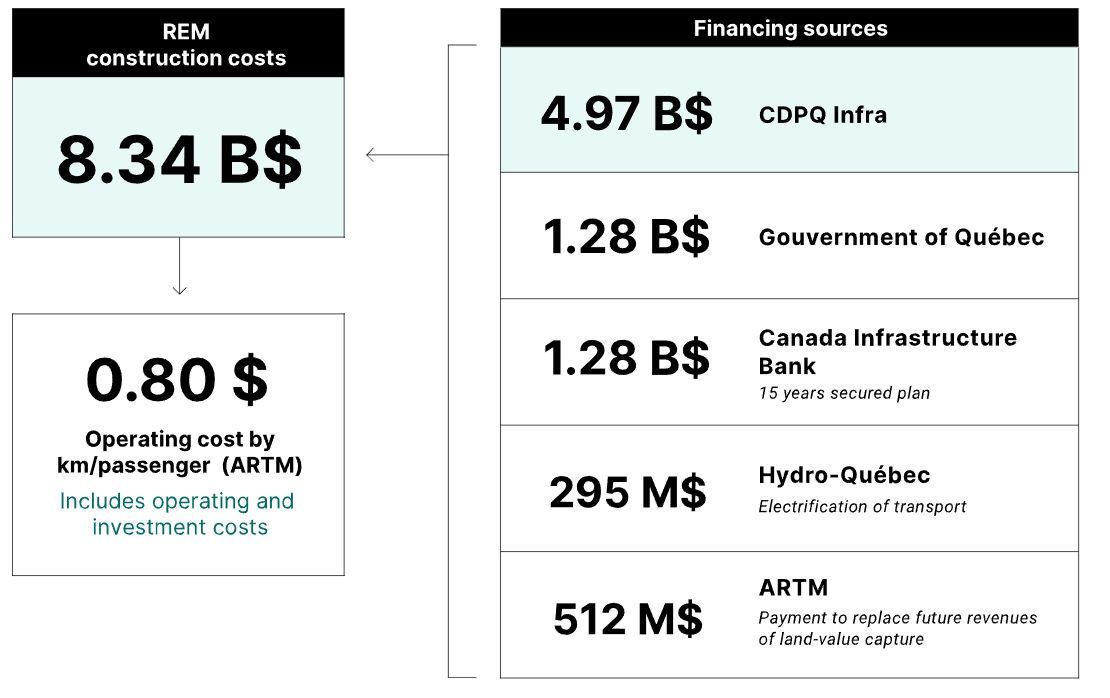
Ever escalating transit and transportation project costs are a scourge across much of the rich world. CDPQ Infra has managed to deliver a massive project — 67 kilometers of fully automated rail for $8.34 billion.
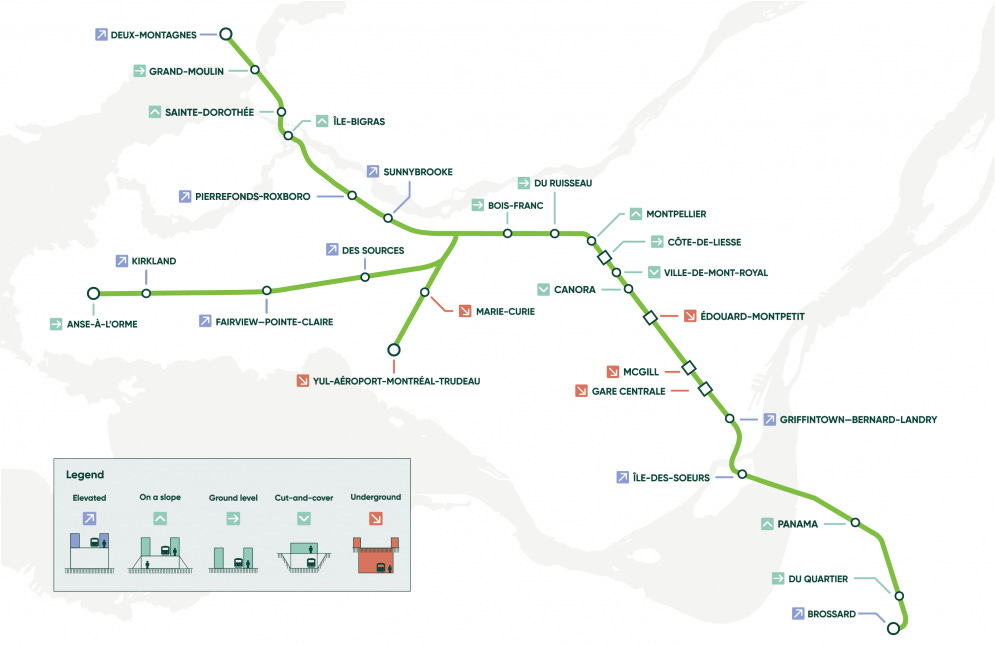
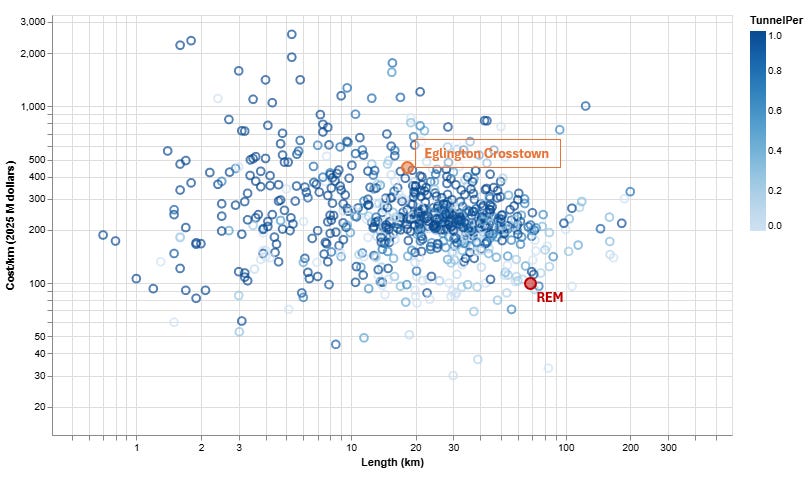
This is about CAD $125 million per kilometer. As projects typically run USD $200-300km, according to the Transit Cost Project, and recent projects, like Toronto’s long-delayed and far less ambitious Eglinton Crosstown LRT, has cost up to CAD $500 million per kilometer. Montreal built a better system for a quarter of the cost.
What’s the cause of the escalating transit cost crisis? I don’t know, but do we even try to contain costs is worth considering. Some politicians see the announcement as the point, the jobs created as the benchmark, and the delivery of a project too far away to wait for. In that case, there’s no incentive to review business plans and bring a harsh lens to every demand, projects quickly become an “everything bagel” where no one is there to say no. It doesn’t help that most projects require coordination of municipal, provincial and federal governments — which inevitably means the lower orders trying to extract as much money from the higher orders of government.
In my view, the role of la Caisse, much beyond simply financing the REM, is in short-circuiting this wasteful cycle. There’s the profit motive, but there’s also the actual skill that’s developed as you run $500 billion fund — being able to come to high stakes decisions quickly and then execute on those investments. In my experience the most impressive professionals weren’t necessarily the sharpest minds, but the best project managers — the folks who could keep every workstream moving along and keep the big picture goal in mind through every inevitable crisis. I would guess there are more of those folks at CDPQ Infra than the transit authority or the provincial government.
Finally, the fact that its a pension fund also disciplines the government. You won’t have nearly as much sympathy from the media or public as if you had a run-of-the-mill Private-Public-Partnership (P3). If you are seen to be jeopardizing or complicating a project, you are also risking pensioners investments.
In reality, pensioners also got a backstop — the province helped structure the deal so that CDPQ Infra gets priority on a base return of 8% per year. It’s not quite a guarantee, but CDPQ Infra’s $4.5bn investment gets its initial fill before the Quebec government $1.28bn' investment. Add in a cheap long-term loan from the Canada Infrastructure Bank at low rate (starting at 1% rising to 3%), and you’ve got a financing structure that makes projects happen and gives them room to breathe in the vulnerable early years.
Is this model transferable? CEO of La Caisse Charles Emond thinks so, as he recently outlined in a great interview with Patrice Roy of Radio Canada:
La caisse… on peut venir aider dans cet esprit-là, à avoir des infrastructures de qualité
CDPQ…can come and help, to develop high quality infrastructure
Example infrastructure assets offered included roads, ports, airports among others.
Personally, I think there’s one hot-button infrastructure project that could really benefit from the Quebec model, can you guess what that is? I’ll follow up in a future blog and you might get a shout-out for guessing correctly.
Are you referring to the Toronto–Quebec City high-speed rail project? My first thought was that it already seems fairly REM-like, since the Cadence consortium has CDPQ Infra as a lead member. Or do you mean that Alto should go even further in adopting the Quebec/CDPQ model?